


It's well known: companies that rely exclusively on bank loans face long terms, collateral requirements and rising costs. But fortunately, the Portuguese alternative financing ecosystem has matured and today offers solutions adapted to all stages of growth.

In this article, I'm going to explain what alternative financing is, share ten strategies that will be valid in 2025 and show you, step by step, how to apply for each one. The aim is clear: to help you raise capital quickly, reduce taxes and maintain control of your business.
Shall we?
What is "Alternative Financing"?
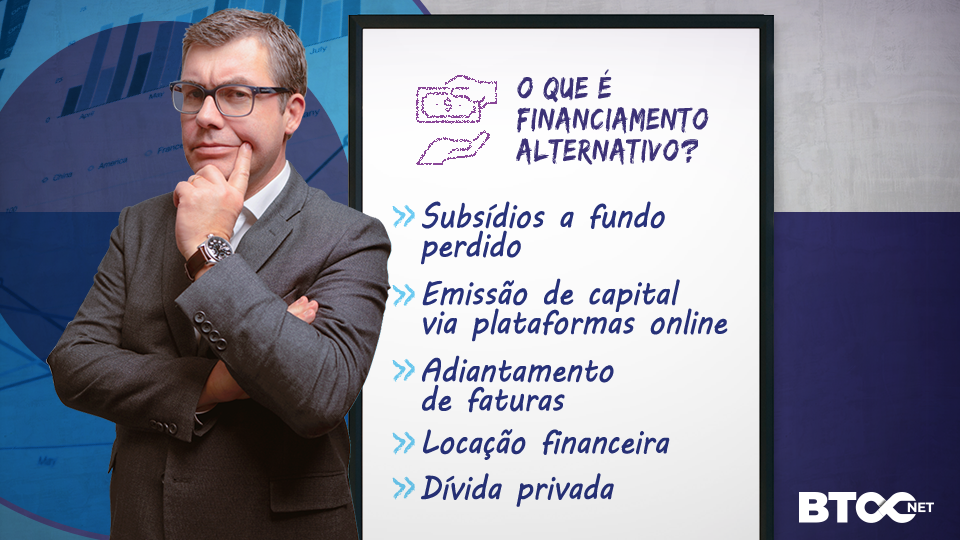
We call alternative financing any source of capital other than a classic bank loan. This includes:
- Non-repayable subsidies,
- Issuing capital via online platforms,
- Advance invoices,
- Financial leasing,
- Or private debt.
These routes have their own rules, varying terms and different tax impacts, but they share two advantages: they diversify risk and can reach your account much faster than a traditional bank loan.
Alternative Financing Options in Portugal
In 2025, Portuguese SMEs have at least ten main ways of raising money outside the banks. Some provide non-repayable grants, others sell shares in the company (equity) or advance invoices to generate cash.
The common rule is to start online: each route has an official portal, a set of basic documents (business plans, balance sheets, tax returns, etc.) and well-defined deadlines. The following list shows you, step by step, where to click, which files to attach and what to expect in terms of costs and benefits.
1 - Public Incentives and Subsidies (Portugal 2030 / PRR)
The new Portugal 2030 framework and the Recovery and Resilience Plan (PRR) have calls for innovation, digitalization and the green transition, with non-refundable support that can cover up to 50% of eligible expenses. These calls for tenders will open up more than €3 billion in 2025 alone.
How to move forward:
- Create an account at the Balcão dos Fundos and activate the "promoter's area";
- Filter "Open Notices" and download the full notice to confirm criteria and percentage of support;
- Attach feasibility study (CAPEX, post-project EBITDA) and detailed budgets in PDF;
- Submit an application and respond to requests for clarification within 10 working days.
When approved, the subsidy reduces the need for indebtedness and the part borne by the company remains a deductible cost in the corporate income tax, generating double tax savings

2 - Crowdfunding and Crowdlending
In this modality, the company presents the project on an online platform (e.g. PPL, Seedrs, GoParity) and many small investors contribute amounts starting at €10; Portuguese law and European regulations limit this to 5 million euros per campaign.
How to move forward:
- Confirm that the platform (Seedrs, PPL, GoParity) is on the CMVM's authorized list;
- Produce video pitch and campaign page with objective, minimum tranche and deadline;
- Comply with KYC/AML within the platform itself and publish quarterly post-acquisition reports.
Crowdfunding boosts brand visibility and doesn't require mortgages, but it does require public disclosure of objectives and results - transparency that can be uncomfortable for those who prefer confidentiality.
3 - Peer-to-peer Lending
Platforms such as Raize e GoParity provide business loans of between €10,000 and €250,000 with a decision in 24 to 48 hours, using algorithmic scoring.
How to move forward:
- Registering, uploading IES and financial statements;
- Receive a rate offer (7 to 9% over three years) and accept online;
- Repay via direct debit, maintaining agreed DSCR ratios.
It's an ideal solution for immediate cash flow. However, the rates increase if the indicators deteriorate; and the maximum amount is lower than in a classic bank loan.

4 - Business Angels
Angels are private investors who put up their own money (up to 500,000 euros) and share a network of contacts in exchange for a 10% to 30% stake. One example: the Investors Portugal network organizes pitch sessions in person and online every month.
How to move forward:
- Prepare a 10-slide pitch-deck with the problem, solution, market, team and projections;
- Submit an application for an Investors Portugal Pitch Day ;
- Negotiate term sheets (valuation, pre-emption rights, exit clauses).
Remember that, in addition to the check, the Business Angel opens commercial doors and speeds up product validation - but it implies dilution and more intense reporting.
5- Venture Capital & Private Equity
Funds such as Blue Crow or Bynd VC III have raised 40 million euros to invest in AI and sustainability, with a preferential focus on Portuguese start-ups in the seed stage.
How to move forward:
- Send one-pager (business summary) to the manager; if interested, open data room with key metrics (MRR, churn, LTV);
- Go through due-diligence (legal, tax and environmental assessment) and sign an investment agreement.
Venture capital injects large sums and usually brings professional management, but it implies significant dilution and ambitious growth targets imposed by the fund.
6 - Direct Lending / Private Debt
A practical example: the Capitalize Mid Caps of Banco Português de Fomento finances projects up to 25 million euros, with a maximum term of 12 years.
How to move forward:
- Request a proposal from the BPF or private funds(Iberis, Alteria);
- Deliver pack of covenants (financial conditions): such as minimum EBITDA of 2 million euros and debt/EBITDA ratio below 3;
- Negotiate guarantees or credit insurance, if required.
This is non-dilutive debt with long maturities; failing the covenants can, however, trigger penalties or require early repayment.

7 - Factoring & Invoice Discounting
Selling invoices to a factoring company allows you to advance up to 90% of the value in 24 hours; as part of this practice, ALF reports an all-time record in 2023, with 44 billion euros of invoices transferred.
How to move forward:
- Send a list of clients and payment terms to the factoring company.
- Sign framework contract; receive immediate advance payment;
- When the client pays, the company writes off the amount owed and returns the remainder, minus commission.
Because it matters: it frees up cash without increasing bank debt - but if the transfer is "with recourse", the company covers bad debts.
8 - Leasing & Sale-leaseback
Leasing finances 100% of an asset (car, machine) and allows you to deduct all rents from your corporate income tax (IRC); you don't pay stamp duty on interest, according to the business press.
How to move forward:
- Request quotes from three rental companies (Santander, BNP Paribas Factor, DLL);
- Compare TAN, initial down payment and residual value; choose financial or operational leasing;
- Deduct 100% of rents as a cost and recover VAT on commercial vehicles.
This solution lowers tax and preserves liquidity, but entails a higher total cost if the asset depreciates quickly or if you don't exercise the call option.

9 - Microcredit & Finicia
The program Finicia program (IAPMEI) provides up to 25,000 euros with 75% guarantees via mutual guarantee companies, aimed at start-ups and micro-businesses.
How to move forward:
- Register at iapmei.pt → Finicia; upload simplified business plan;
- Submit application to the bank; after approval, sign contract with SGM.
It's a gateway for those with no credit history; the amounts are modest and the rates are in line with micro-enterprise risk.

10 - Hybrid fintech (equity + debt)
Platforms such as Five Credit or SeedBlink set up rounds combining the sale of shares and convertible bonds, while HeavyFinance finances agricultural projects and generates carbon credits.
How to move forward:
- Comply with KYC, submit "deal room" and define equity versus debt tranche;
- Publish quarterly KPIs to unlock future tranches or convert the note.
It is flexible and pan-European, but requires permanent digital transparency and the acceptance of investors spread across several countries.
In other words!
Choosing the ideal path requires aligning the term, effective cost and tax consequences with the stage of the business. By combining, for example, a Portugal 2030 incentive for CAPEX and factoring for treasury, an SME can reduce the average cost of capital, maintain liquidity and still benefit from tax increases on leasing rents.
Before submitting any application, always validate the accounting framework with your accountant, ensuring that every euro raised translates into a sustainable competitive advantage.
Advantages and risks of alternative financing
In practice, "alternative financing" means replacing part of bank loans with public support, digital platforms or private investors. The big advantage is the speed or the non-refundable money:
- A Portugal 2030 subsidy covers up to half of the investment and does not generate debt;
- While factoring deposits up to 90% of the invoice within 24 hours, improving the cash balance;
- Other modalities bring market knowledge: Business Angels, in addition to capital, usually help to find customers and suppliers.

On the risk side, there is always a catch:
- Selling shares to a Business Angel means giving up 10 to 30% of the capital and sharing decisions;
- Crowdlending (P2P lending) charges higher interest rates if the company misses financial targets; the regulator itself warns that the risk of default is high;
- Applying for public incentives, on the other hand, requires a detailed dossier and months of waiting; if the targets are not met, the subsidy can be partially returned
That's why, before choosing, it's vital to compare total cost, time to obtain and accountability.

How to choose the right solution
Many entrepreneurs ask themselves: "What is the best solution for me?". The answer depends on four simple questions:
- How much money do you need and what for?
- Up to €300,000 to pay suppliers quickly? Factoring or P2P will sort it out in a matter of days;
- Need a million euros to buy new machinery? Leasing finances 100% of the equipment and allows you to deduct the rent from your corporate income tax. - How urgent?
Factoring and P2P release money in less than a week; Portugal 2030 incentives take 3-6 months from application to 1st Portugal 2030 payment. - Do you want new partners or not?
If you don't want to dilute capital, avoid Business Angels or equity crowdfunding; opt for a subsidy, leasing or private debt. - What is the tax impact?
Leasing rents are 100% deductible cost and the part not covered by the subsidy remains deductible in IRC.

The final decision must balance these four answers. One possible solution is to combine: leasing for machinery, factoring for cash flow and a Portugal 2030 subsidy for R&D tests. In this way, the company obtains immediate liquidity, reduces taxes and doesn't hand over shareholdings.
Comparative Example
Imagine an SME that needs €250,000 to modernize production. Four paths were analyzed:
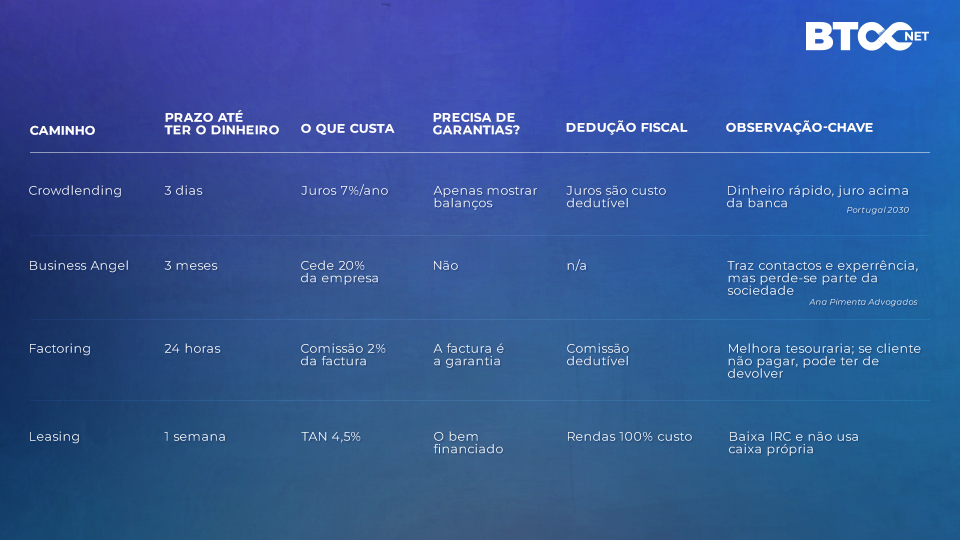
In this scenario, the manager opted for leasing: he secured the equipment in good time, deducted all the rents and avoided high interest rates or the transfer of capital. Factoring was left as "plan B" to solve cash peaks; and crowdlending was ruled out due to interest costs. Business Angel was put on hold for a future phase of commercial expansion.
FAQ
Does Crowdfunding pay VAT?
No; it is raising capital, but requires accounting reporting under the terms of Law 102/2015.
What is the legal limit for crowdfunding?
5 million euros per project in accordance with EU Regulation 2020/1503.
Factoring increases debt?
In SNC it can be "off-balance" if the risk of collection is transferred to the factoring company.
Is leasing interest deductible?
Yes, rents include capital and interest, both tax costs, and no Stamp Duty is levied on interest.

Are there public lines of private debt?
Yes, the BPF's Capitalizar Mid Caps Line offers terms of up to 12 years with a partial guarantee.
Conclusion
Alternative financing is now an essential part of Portuguese companies' capital strategy. By combining public incentives, digital platforms and instruments such as leasing or factoring, it is possible to reduce the average cost of capital, speed up access to funds and optimize taxes.
Before going ahead, carefully assess risks and reporting obligations and talk to your accountant to ensure that every euro you finance translates into a real competitive advantage. If you need help, remember that we are here to support you in your decision making!

